

Health Indicators
For a more in-depth look at the signs and symptoms of common health problems, please visit the Medical Library
The Grimace Scale
The grimace scale is a handy guide used in research and veterinary practices alike to provide a means of assessing discomfort in rats. Created by the National Centre for the Replacement, Refinement, and Reduction of Animals in Research (NC3Rs), this guide is backed by research that demonstrates how changes in facial expressions correlate to pain. As rats are prey animals, they hide pain well and only show minimal signs until they are severely unwell. Understanding the grimace scale can help aid in catching illnesses and injuries well before they become veterinary emergencies.

The Rat Grimace Scale, by The NC3Rs
Body Condition Scoring
Just like humans, rats come in a variety of shapes and sizes. Weight is exceptionally variable between rats, and 400 grams may be a completely healthy weight for one whereas 400g is dangerously underweight for another. The best way to determine if a rat is under, over, or at ideal weight is through the dangle test. To do this, you will be evaluating the front, with your rat’s abdomen facing you. For accurate results, scruffing is best, but if you are unable to get a good hold, you can place your thumb and forefinger under the shoulders and stretch the body out.
If the rat is at a good weight, sides will appear to go straight down, or have a slight definition. If the rat is underweight, sides will appear to curve inwards, and if the rat is overweight the sides will “bulge” outward.
Underweight

Ideal

Overweight

Photo Credit: @th39o on Discord
Photo Credit: @camoiety on Discord
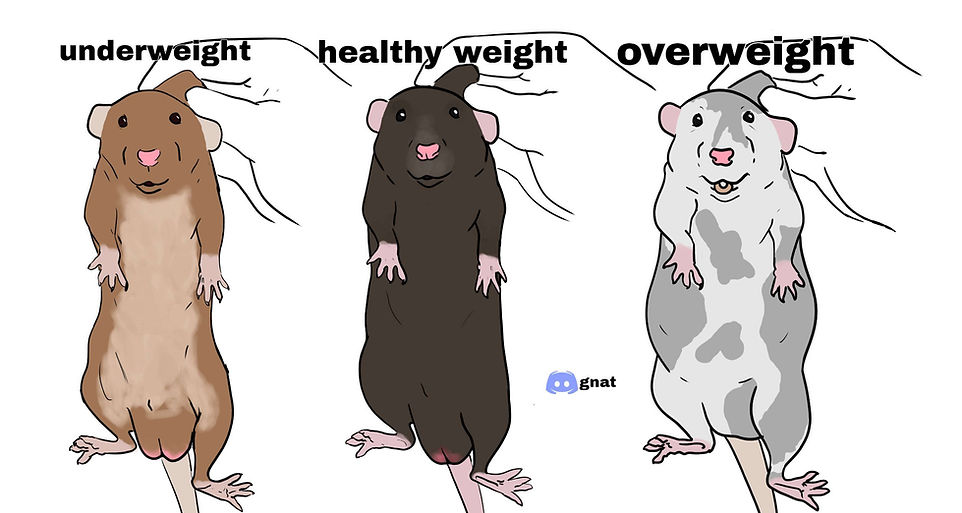
Body Condition Scoring Guidelines. Graphic Credit: @gnat on Discord
Respiratory Distress
Respiratory illnesses are one of the most common ailments of pet rats. When a rat become immunoompromised due to physical or environmental stress, an opportunistic bacteria living in the lungs known as Mycoplasma pulmonis multiplies, eliciting an immune response. With the immune system fighting off the bacteria, inflammation and secretions increase in the lungs, nose, and throat. If the body is unable to reduce this inflammation on its own, a respiratory infection can result. This begins as an upper respiratory infection (URI), but can progress to a lower respiratory tract infection, and in severe cases, pneumonia.
The starting signs of URIs are often difficult to catch, but most cases are comprised of a series of stages categorised by breathing effort:
-
Mild stage - rat may appear slightly “puffy” and sneeze excessively. Congestion may be present, with mild crackling in the lungs. A small chirp/click/wheeze sound can be heard alongside the sneezes.
-
Mid stage - rat will become noticeably puffy, indicating pain and discomfort. The rat may start to be lethargic and drop a small amount of weight. Sneezing and respiratory wheeze will be more prevalent and consistent. Respiratory rate will appear more forceful.
-
Late stage - rat is exceptionally lethargic and feels almost “weak” when lifting them up. Severe respiratory distress will include signs such as side sucking and open-mouth breathing (gasping). This is an IMMEDIATE MEDICAL EMERGENCY as the rat is unable to properly get oxygen to their lungs.
The sooner a rat is seen, the greater the chance of recovery. If a rat is past stage 2, there is poor prognosis, especially if it progresses to a LRI or pneumonia. It is for this reason that rats must be seen by a veterinarian as soon as possible. Respiratory illnesses can cause a rat to go downhill in as little as 12 hours from the start of symptoms and needs proper medical attention. If not treated, respiratory illnesses are fatal. They will not resolve on their own.
Mild Stage
Mid Stage
Late Stage
Note the increased breathing labour causing the sides to "suck" inwards
Video Credit: @hanaverion on Discord
Increased breathing labour, side sucking, and puffiness present. Hunched posture indicative of being uncomfortable and in pain.
Severe, laboured breathing coupled with side sucking, lethargy, and gasping. Rat needs to be put on immediate supplemental oxygen therapy.
Sounds accompanying side sucking and hunched posture, indicative of respiratory distress.
Video credit: @potats on Discord
Choking
Unlike humans, rats are unable to vomit. As a result, when a rat is choking it will appear that they are almost “gagging” without actually doing much of anything. A rat may push back their ears, open their mouths, and can sometimes even drool in response to whatever is stuck in the back of their throat.
Usually, choking resolves itself over a short course of time, as rats are pretty good at taking care of it on their own. There is no need to interfere, as this can sometimes make the situation worse by accident. However, in the event of an emergency it is essential that you take matters into your own hands to prevent your rat from dying. Choking is only an emergency if you see signs of oxygen deprivation. Signs will include: loss of colour in the limbs, blue tongue, lack of motion or intense gasping attempts.
In the event of oxygen deprivation, take the rat between your hands and make sure you are supporting the neck and spine. The rat’s head will be between your fingers, with the rest of the body on the palm of your hand. Lift the rat above your head with your arms straight. Spread your legs and sharply swing the rat between your legs. Repeat this a few times until the blockage becomes unstuck and bring your rat to a veterinary professional as soon as possible.

Choking
An example of a rat mildly choking on a piece of cheese. Note the folding back of the ears.
Drooling
An example of a rat drooling following an impactful choking episode.
Video Credit: @eggisoup on Discord